Thursday, November 3, 2016

Friday, July 1, 2016
Mission of Our Defence and Aerospace Portals
It
is to clarify that our effort is to aggregate Defence and Aerospace
companies to create a credible database for use by the Industry for
their supply chain management, and offsets.
We only endeavour to keep the Portal operational for use by the Industry/Units.
It is a Self-Service for the Companies/Units.
9350171232
Monday, June 27, 2016
Defence Offsets India Fund: A Way Forward
Offsets come in 'Cash and Kind'. Leakages in Offsets are common.
It is prudent that we create Defence Offsets India Fund regulated by an Agency of the MoD on the Concept of Escrow Account to utilise it efficiently, and prevent any leakages. Each Offset Project could be assigned money from this Fund. All inflow /outgo from the Fund are properly accounted.
In such a concept Obligors and MoD (Buyers) work in close co-ordination.
Svipja
Thursday, June 23, 2016
Made in India, Make in India, FDI, Modern Technology Transfer in Defence and Offsets
Made in India; Make in India, FDI, and Modern Technology Transfer in Defence and Offsets
There have been wide ranging changes in policy on Defence Manufacturing in recent years including FDI support. FDI ultimately relates to Equity Holding in Indian Companies, sharing control with the Investor Partners. It would entail compromising ownership and related issues in our Defence Firms. Are we permitting such a condition?
Defence PSUs / Govt. Units, Vs, Private Sector Manufacturing is another issue. Farming Procurement Orders to the Private Sector is likely to remain in controversial discussions all the time...... a Major Policy Challenge!
Presently most of the Defence Manufacturing and Control is with the Govt. Organisations. Its transition to the Private Sector has to be gradual. We must move to it Sub-System/System-based, and %-wise. Let us achieve 10% manufacturing of major systems for the Defence Forces in the Private Sector first in certain time frame on PPP Model, or some Other Model. Balance % of Systems selected for manufacturing in the Private Sector can be gradually assigned to them on seeing success of the first assignment.
Made in India, Make in India then moves forward with FDI and Modern Technology coming from Abroad in certain cases.
We must retain our independence in all its facets in Defence.
Caution!
Friday, May 27, 2016
My Thoughts on Offset Management in the Indian Context Without Any Leakages
These
Pts are listed on www.IndianDefenceIndustry.blogspot.com Most of them
have been addressed in DPP 20013 and 2016, but others , not yet done,
need active consideration. Dates indicated are the Postings on my Blog;
so being highlighted again.
03
Oct 2011
Please read below my Post on
'Defence Offsets India Fund' dt Jun 28, 2008.
We still feel that
India should
create a PE Fund to Develop Indian Defence Industry incl MSMEs for
Inclusive
Growth with Seed Funding by the MOD, & Cash out of Unabsorbed Offset
Funds due from the Obligor(s). A difficult proposition, but must be
discussed.
In addition, the following should
be considered:
1. Banking of offsets beyond the
present limit to 10 years and above in case of infrastructure,special and greenfield
projects rendering value to the Indian Defence Industry.
2. FDI 26%, and extendable to 49%
with approval. Anything beyond this has to be discouraged to retain our
'freedom'; commerce is not end all of everything.
3. Defence & Aerospace high-tech
start-ups should get their rightful share of Offsets. Creation of long-term
value addition should be seen in these companies.
These are some of the points that
merit attention, especially in the backdrop that we may not get the desired
technology thru the offset route.
I feel that we should:
1. Permit offset banking. Will encourage Prime Contractors to invest in projects of relevance for India with long gestation period. And also Provide 'X Factor' of more than one in technologies relevant to India in short-term for credit.
2. Permit Indirect Offsets in Dual-Usage
Sectors of strategic relevance to India.
3. ‘High-Tech, High-Worth, Knowledge-Based’
incubation are in Start-Ups & MSMEs. Would be more so in future. At least 40% of the offset
funds be targeted for investment in such units. Large Enterprises tend to be
‘wasteful’. They must grow ‘organically’, or seek funds from the FIs.
4. ‘Defence Offsets India Fund’,
if created, would help in better Control & Management ( of the Offset Fund).
5 . We must accept offsets both in ‘Cash
& Kind'.
6. Prevent Leakages.
7. ‘Multi-Expertise’ Agency to manage Defence Offsets.
8. See through 'lobbying'.
These thoughts could help.
We could fine-tune Indian Offset Policy as we gain experience ; at least every 2-3 years.
These thoughts could help.
We could fine-tune Indian Offset Policy as we gain experience ; at least every 2-3 years.
Brigadier (Retired) Sukhwindar Singh
MTech (IIT, Delhi), MSc (Defence Studies), PGDM/
MBA, Fellow IETE, Member CII, IDSA, USI.
Friday, December 25, 2015
Services as an Eligible Avenue of Offset Discharge in Defence
MoD has reinstated Services as an Eligible Avenue of Offset Discharge in Defence Offset Guidelines (Appendix D to Defence Procurement Procedure). Following have been reinstated:
Maintenance, Repair and Overhaul.
Upgradation / life extension.
R&D services (from Government recognised R&D facilities).
Engineering, design and Testing as well as software development have been reinstated with a maximum cap of 20 per cent of the total offset obligation with provision of random audit to verify value of offset contracts and additional requirement of CMMi certification of 4 and above category for the IOPs where discharge is envisaged above 5 per cent of offset obligation.
Quality Assurance and Training would continue to be under abeyance.
These changes will apply to the relevant provision of earlier versions of DPP as well.
The change is applicable with immediate effect for RFPs issued on or after the date of issue of this amendment.
Maintenance, Repair and Overhaul.
Upgradation / life extension.
R&D services (from Government recognised R&D facilities).
Engineering, design and Testing as well as software development have been reinstated with a maximum cap of 20 per cent of the total offset obligation with provision of random audit to verify value of offset contracts and additional requirement of CMMi certification of 4 and above category for the IOPs where discharge is envisaged above 5 per cent of offset obligation.
Quality Assurance and Training would continue to be under abeyance.
These changes will apply to the relevant provision of earlier versions of DPP as well.
The change is applicable with immediate effect for RFPs issued on or after the date of issue of this amendment.
Wednesday, November 25, 2015
DPP 2013 , Defence Offsets Policy and Their Proposed Revision in 2015
I am NOT writing any Posts on the latest DPP, and the Defence Offsets
Policy , both under revision, presently. Lots come in the Press.
We will only log Posts once the documents are finally released by the MOD.
We are 'quiet' and 'patient' till then.
All the Best for 'Make in India' Initiative!
We will only log Posts once the documents are finally released by the MOD.
We are 'quiet' and 'patient' till then.
All the Best for 'Make in India' Initiative!
Saturday, February 21, 2015
Offset JVs with MSMEs
Reaching Indian MSMEs for Offset Projects could be a tedious process. Whom should we Partner with, and for which Products / Services? This needs to be a transparent, totally professional and ethical approach, especially during due diligence of 'the to-be-partner' company. It needs to be one2one between Foreign OEM and the Indian MSMEs. Govt. should only intervene if the would-be company is blacklisted, or unethical. As regards its technical competence, financials, and other attributes, let Foreign OEM be the sole judge. This will make the MSMEs rise from start-up stage. It will avoid a great deal of inadequacies, and the OEM would then be wholly responsible and accountable for any lapses.
Implementation of the Offset Projects should be strictly monitored.
Monday, February 16, 2015
'Made in India' and India-Owned e-Hub for Dual-Use Defence and Aerospace Products/Services
Our Defence and Aerospace e-Hub www.IndianDefenceIndustry.com / www.FreeMarketsDefence.com is 'Made in India', and fully owned by us.
At some later date it could have FDI, Technology and Marketing partnership(s). It needs to be further adapted, and grown to harness MSMEs, Indian and Foreign, after due diligence by an independent agency in order to provide reliable and validated database for selection / empanelling for various supply chains. And upgrade its technology on further funding and partnership(s).
Foreign technology and marketing partners who believe in the latest drive of the Indian Prime Minister to "Make in India" are welcome to partner with Svipja Technologies.
Wednesday, September 3, 2014
e-SP2 Concept
e-Selling & e-Procurement Service Provider(s) (e-SP2) is an Innovative Idea.
In this concept, e-Selling, and e-Sourcing / e-Procurement is outsourced by Industry / Companies to experts outside their organisations in line with their Strategy. The goal of the Industry is to retain the existing 'edge' definitely, but still fine-tune 'input costs' with a view not to get 'edged-out' in the emerging environment of globalisation and liberalisation. This helps in making Selling and Buying Processes highly competitive.
e-Platforms are a great support to the e-SP2 Executives. These are professional platforms. The e-SP2 Executives can operate on these platforms freely in their own time, and from the place of their own choosing.
e-SP2 is a very strong business working for retired personnel, self-employed executives, freelance professionals, consultants, etc.
In this concept, the e-SP2 identifies a 'cluster of industry' in his area of operations, and undertakes responsibility to support them as an outside agency for its selling, marketing & procurement functions utilising our Platform www.IndianDefenceIndustry.com.com. e-SP2 can also conveniently support the Uniformed Forces utilising this Platform. In the process, e-SP2:
- Develops a Consortium of SMEs from
- Guides SMEs through the qualified vendor registration processes for the supply chains of major Aerospace-Marine-Defence firms.
The e-SP2 works out commercial terms directly with the supported industry. It becomes his stable and recurring business.
Please also visit my Blog www.FreeMarketsDefence.blogspot.com for more details.
How the e-SP2 compensates Us for the Support provided, can be discussed one-to-one and will be based on case-to-case basis? You are welcome to seek more inputs by writing to Us on ceo@svipja.com
Tuesday, August 12, 2014
49% FDI Permitted in A & D
49% FDI in defence and aerospace is through. This also includes offsets. Would it get wasted out by padding inefficient large units, or would be allowed to reach innovative units bubbling to make the difference? Will MOD officials look at size of the companies as they are used to, or let MSMEs built by highly qualified and energetic entrepreneurs take the shot? Whatever these units innovate and produce as 'pilots', can then be further strengthened by the large units and scale up its production to meet the need.
Refrain from putting buckets of water in oceans. Will not make much difference! FDI and FDI in Offsets (Cash and Kind) are to be viewed alike in Indian context.
Thursday, July 10, 2014
49% FDI Announced in the Budget Today
India will allow foreign direct investment in the defence sector to 49%, up from 26% now, while keeping management control in domestic hands, finance minister Arun Jaitley said in the Union budget today, 10 Jul 2014. This may get finally approved.
Wednesday, May 28, 2014
We Make Offsets Work for A & D Majors of US/EU, and the Indian Defence Industry with MSMEs Focus
We in close co-operation with Indian Offset Partner(s) will assist US Defence and Aerospace Companies such as Boeing, Raytheon, Northrop Grumman and others in the identification and development of offset projects for India in the format required by these A & D Majors for evaluation on case by case basis. We will also support in offset fulfillment by these companies during the offset implementation Phase.
We help you in developing Business Plan for a JV with Obligor(s)/Vendor(s) and undertake due diligence for venture essentials, including structure, equity and ownership issues, planning of product lines/services, marketing, etc in order to ‘pre-assess’ Indian firms as “Indian Offset Partners” (IOPs). The Effort is detailed by our JV TTT Svipja Defence and Aerospace Development Company (TSDADC), Arizona/USA. This would help the business in Offsets, and provide ‘solution-made-easy’ for the OEMs in pre-Bid and after-Bid Stages. Once a venture receives recognition of its validity as a new JV business ,at home and abroad, OEMs would gladly join-in under the Offset Regulations.
This comes to you as a private effort on a Partnership plus Consulting Fee basis, or as mutually agreed.
Monday, March 24, 2014
Offsets Facilitation Cell DOMW/MOD
The Ministry of Defence (MOD) proposes to set up a Facilitation Cell of the Defence Offsets Management Wing (DOMW) at SCOPE Complex, Lodhi Road New Delhi
With the proper operartionalization of the Facilitation Cell, the foreign vendors and the Indian Offset Partners (IOPs) will be able to clarify their queries on offset related issues. The Cell is proposed to be manned on all working days of the week. A team from MOD will also be available on Tuesdays between 1000 and 1300 hours, and on Thursdays between 1430 and 1700 hrs.
The following is important:
- Due authority be delegated to the Cell on Offset matters. All clarifications be in writing or on e-mails. Personal meetings be encouraged. Working on the Internet within security constraints is needed.
- The Staff manning the Cell, needless to say, should have public face. DEO/MOD could be emulated. It is a functional model of the MOD.
- As offsets relate to defence contracts, due care be taken in interface by the Staff with Public/Companies.
- Ethics, Probity, and ‘fire’ to strengthen the Indian Defence Industry are important.
May be our 'Defence and Offsets Facilitation Portal',www.IndianDefenceIndustry.com, duly adapted, can fill the void straightaway.
Brigadier (Retired) Sukhwindar Singh
www.svipja.com
Wednesday, October 30, 2013
"Services and Software Projects" Held in Abeyance for Offsets
We need to pragmatically device ways to curb/control corruption in contracts, and in offset projects alike. Type of software projects that could fall in the ambit of offsets and right valuation aspects of such projects could be rationalized. Certain software projects in which there are many stakeholders, and the projects which as standalone do not make a business proposition but benefit the Indian Defence Industry as a whole including making processes efficient and transparent, could be a fit case as offset projects.
Valuation of the projects could be done diligently to avoid over-pricing.
Answer to 'overweight' is NOT to stop eating but having a diet that is 'healthy enough to make one live decently yet reduce weight' --- a sermon worth attempting in offset projects too.
Sukhwindar
Wednesday, July 31, 2013
Offset Fulfillment - The Right Way!
Obligors see offsets fulfillment against their contracts as yet
another business opportunity. They would therefore invest in only such projects
that are profitable ultimately, of course earning offset credits for the
obligors in the process.
‘Mapping’ of offset recipients by the Obligors, or their
designated agencies is a tedious process. It is here that ‘Global Offset
Services Providers’ approved/empanelled by the Vendors play an important role
in due diligence, ToT, training, consulting, etc, of the Offset Recipient
Companies.
Online and Offline Services are needed for successful
implementation of Offsets.
We provide the complete services in co-operation with our
international JVs.
Thursday, February 7, 2013
Industrial Co-operation and Offsets Facilitation Portal
In order to develop Industrial Co-operation and discharge offsets in various segments, database relevant to Offsets and Information System, detailing capabilities of various A & D in-country Companies is needed. This would help many professionals in major A & D Companies and other stakeholders access the details conveniently from their place of work before off-line discussions commence.
Effort of Svipja Technologies is to create such a database and info system on www.IndianDefenceIndustry.com / www.FreeMarketsDefence.com for India, and integrate it with global platform(s) relevant to A & D Supply Chains.
We urge A & D Companies to Register on these Sites and take advantage of the facilities/contents on the e-Hub including its proprietary transactional Marketing Engine for Buying/Selling/Purchases/Exports, Exhibition Gallery, What's New, etc.
We provide you online and offline offset services.
We provide you online and offline offset services.
Tuesday, December 11, 2012
Dassault Aircraft Services India Private Limited (DASIPL)
After winning contract for supplying 126 Rafale fighter aircraft to IAF, French Dassault Systems has opened an Indian subsidiary company in India.The company named Dassault Aircraft Services India Private Limited ( DASIPL) has been set up recently and it is 100 per cent owned by its French parent company.
Dassault is presently negotiating the terms and conditions, and the final price of the aircraft. with GoI , DASIPL is headed by Richard Lavaud (French).
Dassault has also entered into an agreement with Reliance Industries Limited (RIL) for partnering in defence and homeland security sectors in the country.
There was a possibility that DASIPL and Reliance work together in the combat aircraft deal.
After finalising the deal, Dassault will have to reinvest 50 per cent of the contract's worth back into the Indian defence sector.
Thursday, November 29, 2012
Saab in JV with QuEST
Saab will set-up aero-structure parts and assembly venture in Belgaum/Karnataka/India. QuEST will hold 74% in the JV with Saab 26%. These parts/assemblies are targeted at Boeing and Airbus acs.
QuEST already provides engineering services to Rolls Royce, GE and Airbus amongst others.
The Partners will initially invest USD 10 m in the JV. The JV is likely to be operational by mid-2013.
Saturday, November 3, 2012
New Defence Procurement Procedure likely in early 2013
The IDS deputy chief urged
industry to develop SMEs, to produce the components going into larger and more
complex system
He said the new DPP would liberalise defence procurement
further. This conformed to industry expectations, as it has been the trend in
successive modifications to the DPP in 2005, 2006, 2008 and the currently valid DPP-2011.
Matheswaran urged private industry to focus less on the high value, high
technology weapons platforms (eg, aircraft and tanks) on which the big defence
money is spent. Instead, he suggested, private industry should emulate the
automobile parts industry by setting up manufacturing units that were part of a
global supply chain. These small units would form the backbone of a countrywide
defence industrial base.
In the MoD’s planning, such a defence industrial backbone is
crucial for maintaining, repairing, overhauling and upgrading the complex
defence platforms that are currently being bought from abroad and manufactured
under licence in India
“Rather than focusing on large weapons systems integration and
manufacture as the only way, I think we need to break down the supply chain
into many component parts, so that you become part of a global supply chain. If
you look only at the Indian military as the only source of your order book,
then you’re not going to have continuous orders for any length of time,” said
Matheswaran.
The IDS deputy chief urged industry to develop small and medium
enterprises, to produce the components going into larger and more complex
system that would eventually be built by large conglomerates like the Tatas,
L&T and the Mahindras.
Highlighting the “enormous” opportunities for private industry,
Matheswaran pointed out the scope for India
Pipavav Defence to get investment from SAAB of Sweden
Pipavav Defence has
signed a stock subscription-cum-shareholders agreement with Saab for the sale
of 24.5 million shares at a price of Rs.82 a share. The transaction is at a 7.75% premium to the average of
Pipavav Defence’s.
Saab will own 3.5% of
Pipavav Defence after the transaction is completed and will have an option to
increase it to 10%.
Wednesday, October 10, 2012
Defence Offsets Management Wing (DOMW)
Defence Offsets Management Wing (DOMW) has been established. The key objective of the Defence Offsets Policy is to leverage Defence capital acquisitions to develop Indian defence industry by:
- Fostering development of Internationally competitive enterprises,
- Augmenting capacity for Research, Design and Development related to Defence products and services and
- Encouraging development of synergistic sectors like Civil Aerospace and Internal Security.

The DOMW under the Department of Defence Production will be responsible for formulation of Defence Offsets Guidelines and all matters relating to post contract management.
The functions of DOMW include:
- Formulation of Defence Offset Guidelines;
- Monitoring the discharge of offset obligations, including audit and review of progress reports received from vendors;
- Participation in Technical and Commercial evaluation of offset proposal as members of TOEC and CNC;
- Implementation of Offset Banking Guidelines;
- Administration of penalties under offset contracts in consultation with Acquisition Wing;
- Assisting vendors in interfacing with Indian Industry;
- Other responsibilities assigned under the Offset guidelines or entrusted by the Government.
DOMW works in close collaboration with Defence Acquisition Wing for smooth implementation of the Offset guidelines.
Sunday, August 26, 2012
SMEs Seeking High-Tech JVs and Offsets
MSMEs and Large-sized companies in India are signing MOUs with Obligors for offsets. It is good enough for initial understanding. It is NOT the MOU that would be very
relevant between companies for business, but Agreement(s) that could be
enforceable by Laws of the Obligor / Home country as negotiated, for safeguards.
Pse see our Offset Process set out
on this Blog. Register on www.IndianDefenceIndustry.com with Your Offset-Savvy Profile, Obtain Industrial License, and become Industry Sector Partner
(ISP) of our US JV to steer through the High-Tech JVs, FDI ; and Offset
Processes, wherever feasible.
We come as
Consultants/Partners to You.
You could seek further
clarifications on svipja@airtelmail.in
Ours is a Private Initiative.
Visit www.IndianDefenceIndustry.com , our e-Hub of India Defence and Aerospace Ecosystem.
Saturday, August 11, 2012
Setting-up of Defence Offsets Management Wing (DOMW)
The DOMW is being set up from scratch. The DDP has so far been authorized a Defence Offsets Facilitation Agency (DOFA), an understaffed agency under a joint secretary, whose duties have been confined to putting foreign arms vendors in touch with prospective Indian offset partners. The DOMW, in contrast, will be higher-powered and more expansively manned. An Additional Secretary will head it, with a joint secretary and six full-time director-level officers under him.
“We are becoming functional right away. Six temporary directors are arriving next week from defence PSUs and the Ordnance Factory Board, until permanent officers can be posted. Eventually, civilian and military officers from all three services will man these six director-level posts,” says a top MoD officer.
Sunday, August 5, 2012
Revised Offset Guidelines
Happy to inform that the new Offset Guidelines have been issued. Connect: http://mod.nic.in/dpm/welcome.html These should be seen in positive light.
All the best!
All the best!
Thursday, July 26, 2012
Adding More to the Indian Offset Policy
There are media reports that the DAC/MOD, India, has modified the Offset Policy further based on experience gained till date in its Meeting on Monday last, 23 Jul. Critical Defence Technologies for Offsets, 1.5 Multiplier effect for Offsets in SMEs, and Creation of Defence Offsets Management Agency (DOMA) has been approved.
These are +ve changes.
Formal Govt. notification is awaited.
These are +ve changes.
Formal Govt. notification is awaited.
Friday, July 13, 2012
Defence Offsets Approval, Implementation and Credits
If malice is within the System, no amount of Policy Parameters
on Offsets will take the Indian Defence Industry on high trajectory. Focus on ‘Business
Gains’ will dilute the Policy in its Execution Phase. We need ‘passion and
drive’ to stay on course to reach the end objective of modernizing the Indian Defence
Industry.
Approval of Offset Projects at the RFP Stage keeping our
needs in view, Project(s) Implementation, and Granting Fair credits are the key
processes.
Must plug the ‘leakages’. Provide flexibility in the Policy
Guidelines, and then execute it flawlessly without any slippages – that is the
mantra for success.
Sukhwindar
Saturday, May 26, 2012
Pilatus Trainer from Swiss for the IAF with Offsets
The IAF will acquire basic trainer,75 Pilatus Planes, starting later this year for Rs 2,800 Crore from a Swiss company. The aircraft will replace its fleet of HPT-32 basic trainer aircraft.
Delivery of the aircraft and the complete training system is scheduled to commence in fourth quarter this year, as per media reports. The ac would be procured together with its integrated ground based training system and a comprehensive logistics support package.
The Pilatus will also do 30 % offsets of the cost of the deal. ToT will also be done to HAL.
Tuesday, May 15, 2012
Defence Offset Contracts Till Now (15 May 2012)
Defence Minister informed the Indian Parliament in writing on 14 May 2012 that 17 contracts worth 4.27 b USD were signed as defence offsets. Out of this, 3.43 b USD were for IAF- related projects and 843 m USD for Naval projects. Nothing for the Army; may be some would come in the coming months.
The budge about the defence offsets in India is right, but unfortunately most of it, for the time being, is for Govt. Units, Large Private Sector Units and DRDO /Other High-End R & D with almost none for micro and small enterprises. SMEs are likely to figure towards the tail-end unless Obligors prefer them. Offsets-Cash/Kind-given to large units are slated to yield low returns for the Indian Defence Industry for various reasons.
ToT-Quality & Depth, Valuation for grant of Offset Credits, Strict Implementation, Inclusive Distribution of Offsets, Plugging Leakages, ETC, should be some of the major concerns of the Govt. and Industry.
Monday, April 30, 2012
Development of Personnel for Offset Implementation
Offsets is a specialized field. You may have military knowledge, industry knowledge, required dynamism and will to contribute to the system long-term in a transparent and ethical manner with probity , but still not be able to serve as an effective Offset Manager / Consultant in the Industry.
We train You in concert with our JV Partner in the US, Tucson Transatlantic Trade Inc. Holding Group, www.ttthg.com
Tuesday, April 24, 2012
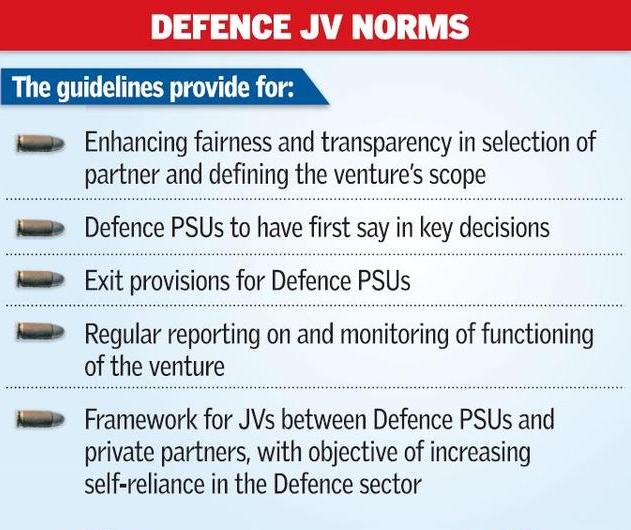
Defence Ventures with Foreign Entities to Face Closer Scrutiny
The Govt. is planning guidelines for defence sector joint ventures (JVs) between Indian and foreign firms. And these will be similar to foreign direct investment (FDI) norms for defence collaborations in certain developed countries.
The idea is to institute security and auditing procedures for JVs and their supply chains. The norms will apply to JVs based on ‘threat perception’ and the sensitivity of products to be manufactured. Such JVs will have to seek prior separate security clearances from the home ministry regarding subsidiaries, directors and foreign nationals (if engaged).
The JV companies must be owned and controlled by Indian residents and their companies. Despite the 26% FDI cap, the defence sector has attracted top overseas defence equipment manufacturers like the UK’s BAE, European consortium EADS, US-based Sikorsky and Lockheed Martin,etc.
Tuesday, April 10, 2012
PPP for ICVs in India
The MOD/India has thrown open its doors for private players to bid for a project to build the Future Infantry Combat Vehicle(ICV).
Two companies will be shortlisted and asked to build one prototype each—the manufacturing of these will be funded 80 % by the Govt.
The Army needs about 2,600 ICVs over 20 years. All four bidders—Tata Motors, Mahindra Defence Systems, L&T and the Government-owned Ordnance Factory Board (OFB)—have presented their designs. The evaluation is set to move to the final phase within a month. The Rs 50,000-crore order is likely to be divided between the winner and runner-up.
Challenges
• The systems integration of the FICV is likely to be a big challenge. The platform, the software and electronics have to be integrated for the vehicle to function well. Indian companies have little experience in this.
• Keeping it local. All the four bidders are likely to have foreign partners. The fear is that the high-end work will be done abroad defeating the purpose of the exercise. Russian aircraft have been assembled in India for decades—yet the design and development of every new generation plane was done in Russia
Read More: PPP for ICVs in India
Wednesday, April 4, 2012
DAC/MOD Eases the Offset Fulfillment Policy
As per media Reports , the MOD on 02 Apr 2012 eased its defence offsets norms with the value of technology transferred under a deal could be written off against the offset The offsets clause is expected to bring in investments of $30 billion in ‘cash or kind’ over the next decade. The revised provisions also make a distinction between equity and non-equity route, that is investment in "kind" made by the OEM for discharge of offset obligations.
"Investment in kind in terms of TOT must cover all documentation, training and consultancy required for full TOT (civil infrastructure and equipment excluded)", the Report said.
The TOT should be provided without license fee and there should be no restriction on domestic production, sale or export. The offset credit for TOT shall be 10 per cent of the value of buy back by the OEM during the period of the offset contract, to the extent of value addition in India.
The guidelines also noted that the technology acquisition by Defence Research and Development Organisation (DRDO) for a list of specified technologies will be treated as an eligible offset with a multiplier up to three.
It has already been decided to allow the tier-I sub-vendors under the main procurement contract to discharge part of the offset obligations on behalf of the main vendor. However, the overall responsibility for discharge of the offset obligations shall rest solely on the main vendor. The agreement between the OEM, vendor and tier-I sub-vendor and the Indian offset partner will mandatorily be subject to Indian laws.
The revised guidelines are said allow offset obligations to be discharged within a time frame that can extend beyond the period of main procurement contract by a maximum period of two years. The overall cap on penalty will be 20 per cent of the total offset obligations during the period of the main procurement contract. There will be no cap on penalty for failure to implement offset obligations during the period beyond the main procurement contract, which may extend to a maximum period of two years.
The period of validity for banked offsets has been increased to seven years.
In the discharge of offset obligations relating to direct export, foreign direct investment and technology transfer or investment in 'kind' in Indian enterprises through non-equity route, a multiplier of 1.50 will be permitted where micro, small, and medium enterprises (MSME) are the Indian offset partners. The monetary limits specified by the Indian government's department of MSME shall be applicable for identification of the MSME.
"In exceptional cases, the competent authority may permit change in offset partners or offset components provided the value of offset obligations remains unchanged. This will provide greater flexibility in implementation", the Report said.
Formal Govt. Guidelines are Awaited.
Tuesday, April 3, 2012
Mahindra JV with Rafael
Mahindra & Mahindra Ltd and Rafael Advanced Defense Systems Ltd, a manufacturer of defence systems for air, land, sea and space applications, today agreed to form a Joint Venture in India to develop and manufacture products such as Anti Torpedo Defence Systems, Electronic Warfare Systems, Advanced Armouring Solutions and remotely operated weapon stations for Futuristic Infantry Combat Vehicles (FICV).
Rafael will make investments in Mahindra's existing Naval Systems division in Pune which will also be the location of a production facility which will be set up to meet the long-term requirements of the JV company.
The companies have also approached the Foreign Investment Promotion Board (FIPB) for creation of a 74:26 company, the company statement said.
Link: Mahindra JV with Rafael
Rafael will make investments in Mahindra's existing Naval Systems division in Pune which will also be the location of a production facility which will be set up to meet the long-term requirements of the JV company.
The companies have also approached the Foreign Investment Promotion Board (FIPB) for creation of a 74:26 company, the company statement said.
Link: Mahindra JV with Rafael
Saturday, March 31, 2012
Def Expo 2012: MOD Reaffirms Its Resolve to Grow Indian Defence Industry
DG (Acquisitions) indication of the MoD’s inclination towards private sector participation by strongly supporting the “Make” procedure. According to the Defence Procurement Procedure, this allows private industry to bid for building complex military platforms, with the MoD funding 80% of the cost of development. There are currently only two “Make” projects being pursued: the Future Infantry Combat Vehicle (FICV); and the Tactical Communications System (TCS).
“To build up the defence base, we need to generate a lot of “Make” procedure (procurements). We will make a list of 150-180 “Make” procedure projects…. to energise the industrial base of the country.
RRM, however, cautioned the private industry not to expect a fully-funded stroll into defence production. “The industry also needs to commit itself to the field in terms of establishing the required infrastructure and develop the capacities. Commitment to R&D effort is also required by the defence industry both in the public and private sector if the long-term goals are to be met,” said Shri Raju.
Wednesday, March 28, 2012
Def Expo 2012 : Curtain Raiser
There are going to be 232 foreign firms, mainly from the US, Russia, France, Israel, the UK and Germany, and 60 official delegations in town this week for the four-day "Def Expo 2012' that begins on 29 Mar.
Over 335 Indian exhibitors, including major ones like Tatas, Punj Lloyd, L&T and Mahindra, will also be there to explore tie-ups and joint ventures with foreign companies as well as DRDO, defence PSUs and domestic shipyards.
"We understand fully well that indigenization cannot happen through only defence PSUs. We have taken several steps to encourage the private sector," said Mr Shekhar Agarwal, Secretary (Defence Production).
The Defence Ministry has been pushing for JVs and Technology Transfers to strengthen the Defence Industrial Base in India. FDI is 26% in the Defence Production Sector.
Full Report: Def Expo 2012 : Curtain Raiser
Tuesday, March 20, 2012
'Man-Machine-Logistics' Optimization
“Indian Air Force (IAF) is highly professional, and its fighter pilots super. A 'flying machine' would always have certain limitations for certain reasons, may be non-compliant in some ways. It is the pilot-machine team that would deliver the results unimaginatively”. Discuss.
This discussion started by Me on Linked-in about a month ago in ‘Aerospace and Defence Group’ is inviting insightful comments and views many ways.
A Very Useful condensed knowledge on fighter ac!
Sukhwindar Saturday, March 17, 2012
Defence Offset Implementation Debate
John Williams has started a very interesting discussion on offset Implementation on Linked-in at
John’s Discussion on Offsets
John’s Discussion on Offsets
My rejoinder on Comments till date is as under:
I did not suggest the Offset Implementation structure in the MOD by design. Wanted it to evolve naturally in Indian conditions.
I think the answer lies in creating an indep 'Offset Implementation Agency' under an Addl secretary/secretary level officer with minimal staff to support it, and expertise drawn, as it is, from the working desks of Acquisition Wing, DDP, DRDO, DGQA, Ministries of Home Affairs and Aviation, Defence Services, etc without burdening the existing MOD set-up for obvious reasons.
Offset Project Approvals should continue to remain with the DOD as of now. Will ensure transparency and probity. DOFA organized to clear the Offset Credits. Offset Implementation Agency just implements offset projects in concert with the offset recipients. In this concept, offset projects approvals, ground implementation of offsets, and approving offset credits are the responsibility of different offices. This would ensure transparency, and the fact that offsets are not diluted/'leaked'.
I am sure the Indian MOD has requisite expertise and experience in evolving organizations meeting Indian ethos. A Single Point Agency, all inclusive, is likely to run into lots of difficulties, and representations/complaints as a result affecting the acquisition process.
The Organization will not be what each stakeholder desires, but an optimized set-up per our system of governance for the strategic sector.
Friday, March 9, 2012
Mirage 2000 Upgrade for the IAF by Dassault and Thales
French firms Dassault and Thales will upgrade is to upgrade IAF Mirage 2000 fleet under a deal worth $2.4 billion. The Indian government has started making payments for the deal to upgrade the Mirage ac as per a media report.
Under the deal, the French firms will help in upgrading the avionics, navigation systems, mission computers, electronic warfare systems and radars bringing the aircraft to the Mirage-2000-5 standards. The French companies will have to invest over $900 million into the Indian defence sector as defence offsets.
As per the agreement, India has sent two of its aircraft to France for upgrades and thereafter the rest would be upgraded at Hindustan Aeronautics Limited facilities.
Under the deal, the French firms will help in upgrading the avionics, navigation systems, mission computers, electronic warfare systems and radars bringing the aircraft to the Mirage-2000-5 standards. The French companies will have to invest over $900 million into the Indian defence sector as defence offsets.
As per the agreement, India has sent two of its aircraft to France for upgrades and thereafter the rest would be upgraded at Hindustan Aeronautics Limited facilities.
Mirage 2000 Upgrade for the IAF by Dassault and Thales
Thursday, March 8, 2012
MOD India Blacklists Six Defence Firms
India has blacklisted six armament firms for 10 years on bribing charges.
The sanctions targets four foreign companies, namely Israel Military Industries (IMI), Singapore Technologies Kinetics Ltd, Switzerland's Rheinmetall Air Defence, and Russia's Corporation Defence (CDR).
The other two companies targeted, RK Machine Tools Ltd and TS Kisan and Co Private Ltd, are both Indian.
Report: MOD India Blacklists Six Defence Firms
The sanctions targets four foreign companies, namely Israel Military Industries (IMI), Singapore Technologies Kinetics Ltd, Switzerland's Rheinmetall Air Defence, and Russia's Corporation Defence (CDR).
The other two companies targeted, RK Machine Tools Ltd and TS Kisan and Co Private Ltd, are both Indian.
Report: MOD India Blacklists Six Defence Firms
DCNS Partners SEC Industries, Hyderabad
DCNS has signed a partnership sub-contract with SEC Industries, Hyderabad
This is a significant win for private sector manufacturer of key defence components. In addition to executing the contract, SEC Industries will benefit from the transfer of technology from the French company.
Saturday, February 11, 2012
Wednesday, February 8, 2012
MMRCA Deal a Shot in the Arm for Industry
The impending $12 billion contract to buy 126 Medium Multi Role Combat Aircraft (MMRCA) by the defence ministry from Dassault, is set to be a game changer for the Indian aerospace and defence industries with about $6 billion worth of offset contracts expected to flow to Indian companies.
This deal, as and when signed, ensures that Dassault along with its two major suppliers Thales and Safran Group would place offset contracts on Indian vendors amounting to minimum of 50 per cent of the value which in this case could be $6 billion and this obligation would be co-terminus with fulfillment, which is 12 years span.
With this, new technology absorption, world class facilities, adaptation of cutting edge processes, systems and the skilled manpower would create a formidable ecosystem for India to compete in the global marketplace.
Of the $6 billion in offset money flowing into India, about 50 per cent is likely to be spent on manpower. On an average of $20,000 per man year, this would mean 150,000 man years of new jobs in the defence aerospace industry. This would translate into 5,000 jobs in the3rd year and stabilize at 20,000 jobs in the ninth year. Also, all support services like maintenance, training and logistics have to be provided by Indian industries with the technology and know-how of Dassault, Thales and Safran for the next 40 years. This could create an additional 4,000 jobs. And more……
Read Full Article: MMRCA Deal a Shot in the Arm for Industry
Wednesday, February 1, 2012
Indian MMRA Competition Declares Dassault Rafale as L1
"The French firm Dassault Rafale has emerged as the L-1 (lowest bidder) and cheaper than its European rival EADS (maker of Eurofighter) in the tender and will be offered to supply the aircraft to the IAF."
French company Dassault Rafale today qualified to bag India's contract for supplying 126 combat ac for the IAF.
Dassault Rafale as the lowest bidder, is likely to get the contract under India's Defence Procurement Procedure. Further negotiations are likely to move with Dassault in this deal.
The TOI Report: Indian MMRA Competition Declares Dassault Rafale as L1
Monday, January 30, 2012
Private Sector Participation in Defence Production: Industrial Licensing and FDI Issues
India has permitted 100 % participation by the private sector in defence sector, with foreign direct investment (FDI) permissible up to 26 per cent in the manufacturing, subject to licensing and security clearance. However, 100 % FDI is permitted in the case of the services sector.
By October 2011, the Department of Industrial Policy & Promotion (DIPP) gave 200 Letters of Intent/Industrial Licenses (LoI/IL) to various private entities, with proposed investment totaling Rs 11,773 Crore, and potential employment opportunities for 38,579 people. By November 2011, a cumulative FDI of Rs 17.68 Crore (US $3.72 m) was received by the Indian defence industry.
As per the guidelines of the DIPP, defence falls under the ‘Manufacturing’ sector. So, the companies in the manufacturing business can apply for a license and get it (subject to approval), and be formally part of the defence industry. However, this is not the case for companies in the services sector (such as, engineering, design and software, etc.), which do not come under the purview of ‘Manufacturing’, and hence do not require a license for their services. Consequently, they are not formally part of the defence industry, even though their services have direct application in defence products.
For the services sector, the equivalent minimum equity share (by the Indian shareholder) is 51 per cent in order to be called an Indian company. However, Defence Offset Facilitation Agency (DOFA) —responsible for facilitating offsets in defence contracts—insists that companies in the services sector must have a minimum 74 % domestic equity share in order to participate as an Indian Offset Partner.
Full Article with Other Implications: Private Sector Participation in Defence Production
Saturday, January 28, 2012
Aerospace and Defence exports likely to reach USD 2 billion in 2011-12
Aerospace and defence exports are likely to clock two billion dollars in the current fiscal, industry chamber Assocham has said.
With about 18% growth during the first three quarters of 2011-12, aircraft exports including component parts stood at about 1.31 billion dollars against 1.11 billion dollars in the corresponding period of previous fiscal, Assocham said.
Parts and components have contributed a major 96% of the total aerospace exports, highlighting India's manufacturing capability in aerospace sector oriented towards tier I, II and III suppliers as against aircraft Original Equipment Manufacturers (OEMs).
Read the Report: Aerospace and defence exports likely to reach USD 2 billion in 2011-12
Read the Report: Aerospace and defence exports likely to reach USD 2 billion in 2011-12
Tuesday, January 24, 2012
Thales-Samtel Defence Systems (SDS) Partnership
Thales has a joint venture company, Samtel Thales Avionics. Thales' offset liability from the Mirage upgrade contract for Euro 1.47 b (Rs 9000 Crores) amounts to Euro 441 m (Rs 3,000 Crores). That induces Thales to source from SDS a significant share of the avionics (aviation-electronics) for upgrading the Mirage-2000. SDS already supplies Hindustan Aeronautics Ltd (HAL) with cockpit displays (multi-function displays, or MFDs) for the Sukhoi-30MKI fighters that are built at HAL's Nashik plant. The Ghaziabad-based company is also competing to build avionics for the IAF's forthcoming Sukhoi-30 MKI upgrade.
And, if the Rafale fighter — built by Dassault with a large avionics component from Thales — is chosen by the MoD as the IAF's new medium multi-role combat aircraft (MMRCA), SDS could benefit enormously from another wave of offset-driven orders for display systems and other avionics in the 126 MMRCA.
And, if the Rafale fighter — built by Dassault with a large avionics component from Thales — is chosen by the MoD as the IAF's new medium multi-role combat aircraft (MMRCA), SDS could benefit enormously from another wave of offset-driven orders for display systems and other avionics in the 126 MMRCA.
Read the Full Report: Thales-Samtel Defence Systems (SDS) Partnership
Saturday, January 14, 2012
Indian Defence Industry, Defence Exports and Offsets
A number of Private Indian A & D Companies have obtained Letter of Intent / Industrial Licenses for manufacture of defence products & Services in India. These products would have markets in India and abroad, quality and price being primary issues. It is important that JVs or any other type of co-operation are set-up with such manufacturers/vendors which bring-in international standards to the firm.
The companies could invest in production themselves, or seek offset funding in addition to other sources of funds. DPP 2011 and other regulations of the MOD/India set the stage for the industry in the Private Sector to develop and manufacture defence products.
We at http://www.freemarketsdefence.com/ / http://www.indiandefenceindustry.com/ are aggregating the industry into the global landscape. This adds value to the industry manifold, in various ways. Please contact Us at svipja@airtelmail.in for your defence exports, offset fulfillment, and any other requirement relating to the Indian Defence Industry.
Thursday, October 27, 2011
Indian Defense Sector Spend by 2015
The Indian defense sector is one of the fastest growing markets globally, with an estimated US$13.9 billion of the annual budget allocated for the acquisition of military hardware and technology in 2010.
Defense expenditure, which refers to the part of the budget that is spent on the acquisition of all types of military hardware and technology, has grown at a CAGR of 12.14% from 2005-09. Defense expenditure is expected to record a CAGR of 6.59% during 2010-15, to reach an annual spend of US$42.6 billion by 2015. This is primarily due to ageing military hardware and technology, domestic insurgencies and hostility from neighboring countries.
Strong growth in the sector is attracting foreign original equipment manufacturers (OEMs) and leading players from the domestic private sector to enter the market. Moreover, terrorism is leading to sharp increases in the defense budget and a shorter sales cycle, which translates as an attractive market for defense manufacturers.
The areas that are specifically expected to emerge over the short to medium-term include unmanned combat aerial vehicles (UCAVs), advanced electronic warfare systems, combat systems, rocket and missile systems, fighter and trainer aircraft, stealth frigates, and submarines. In addition, spend on IT and communications is expected to increase significantly, with a strong focus on enterprise applications, systems integration, and real-time mobile communications.
Among the defence services the Army with a budget of approximately Rs. 74,582 Crores in 2010-11 has the largest share, followed by the Air Force (Rs. 40,462 Crores), Navy (Rs. 21,467 Crores), DRDO (Rs. 9,809 Crores), and Ordnance Factories (Rs. 1,015 Crores).
Credit: USIBC and Its News Agencies
Thursday, October 13, 2011
MoD Approves Offset Proposals for the MMRCA Deal
The defence ministry approved the offset proposals for the MMRCA Deal paving the way for opening the commercial bids.
The offset proposals from Dassault Aviation (Rafale) and the Eurofighter consortium (Typhoon) were presented before the DAC by director general acquisition Vivek Rae. Besides the Defence Minister, the two-hour meeting was attended by the three Service chiefs, the Defence Secretary, the Secretary, Defence Production, the DG (Acquisition) and concerned joint secretaries in the Ministry.
Foreign vendor bagging MMRCA Deal will have to invest back 50 per cent of the worth of the deal in Indian Defence Industry. This means investment of more than Rs 21000 Crore in India, in military, homeland security and civil aviation.
The offset proposals from Dassault Aviation (Rafale) and the Eurofighter consortium (Typhoon) were presented before the DAC by director general acquisition Vivek Rae. Besides the Defence Minister, the two-hour meeting was attended by the three Service chiefs, the Defence Secretary, the Secretary, Defence Production, the DG (Acquisition) and concerned joint secretaries in the Ministry.
Foreign vendor bagging MMRCA Deal will have to invest back 50 per cent of the worth of the deal in Indian Defence Industry. This means investment of more than Rs 21000 Crore in India, in military, homeland security and civil aviation.
Monday, October 3, 2011
Defence Offsets India Fund & Offsets
Please read below my Post on 'Defence Offsets India Fund' dt Jun 28, 2008.
We still feel that India should create a PE Fund to Develop Indian Defence Industry incl MSMEs for Inclusive Growth with Seed Funding by the MOD, & Cash out of Unabsorbed Offset Funds Due from the Obligor(s). A difficult proposition, but must be discussed.
In addition, the following should considered:
1. Banking of offsets beyond the present limit to 10 years and above in case of infrastructure,special and greenfield projects rendering value to the Indian Defence Industry.
2. FDI 26%, and extendable to 49% with approval. Anything beyond this has to be discouraged to retain our 'freedom'; commerce is not end all of everything.
3. Defence & Aerospace high-tech start-ups should get their rightful share of Offsets. Creation of long-term value addition should be seen in these companies.
These are some of the points that merit attention, especially in the backdrop that we may not get the desired technology thru the offset route.
Svipja Technologies
Subscribe to:
Posts (Atom)